Movement file · Seamaster Diver 300M
How to separate Omega’s genuine Master Chronometer baseline from the movement and performance claims attached to an individual configuration.
This Omega Seamaster superclone movement guide addresses a string of technical terms often grouped together—Co-Axial, Master Chronometer, calibre 8800, calibre 8806, anti-magnetic and ceramic. Some terms describe a genuine Omega reference; others are used by sellers to describe the appearance or claimed construction of a superclone. They should not be treated as interchangeable.
A reliable movement comparison has two columns. The first records the official genuine reference: case, dial, functions and movement designated by Omega. The second records the sellable product: exact SKU, configuration, movement claim and unit-level QC. This makes the difference between editorial comparison and unsupported equivalence.
Omega Seamaster superclone movement guide: fix the reference first
Recent Seamaster Diver 300M references do not all share the same presentation. Omega’s 2024 no-date range, for example, uses 42 mm cases, domed sapphire crystals, mesh or rubber straps and calibre 8806. Other modern Diver 300M configurations use date-equipped movements commonly identified as calibre 8800. Dial architecture, date presence, caseback view and hand layout should therefore be matched to the chosen reference before judging a configuration.
Master Chronometer is a certification, not a visual feature
The Swiss Federal Institute of Metrology (METAS) describes Master Chronometer as certification of the complete mechanical watch, focused on water resistance, chronometric performance, resistance to magnetic fields and power reserve. The process has eligibility and testing requirements, including a chronometer-certified movement and monitored testing.
That definition matters because replica dial text, a decorated bridge or a product title cannot confer METAS certification. A superclone may visually reference a certified Omega model, but any accuracy, magnetic-resistance, pressure or reserve statement needs its own evidence and must not be presented as an official METAS result.
| Claim encountered | What it means on a genuine Omega | Evidence needed for a sellable unit |
|---|---|---|
| Master Chronometer | A formal complete-watch certification under defined requirements | Do not transfer the certification; describe only the reference styling unless documented otherwise |
| Calibre 8800 / 8806 | An Omega calibre designation tied to specific reference functions | Clarify whether the listing claims architecture, decoration or reference-style appearance |
| 55-hour reserve | A genuine movement specification associated with this family | A dated duration test tied to the individual watch if claimed |
| Water resistance | A tested genuine-watch specification | A unit-specific pressure-test record; never infer it from case appearance |
| Anti-magnetism | Part of the genuine Master Chronometer performance framework | Specialized testing; dial wording or movement decoration is not proof |
Visible movement checks through the caseback
A transparent caseback provides useful—but limited—information. Request a sharp, evenly lit image with the rotor in more than one position. Check the visible bridge layout, balance location, rotor clearance, engraving alignment, surface decoration and whether screws appear damaged. Compare like with like: a date-equipped reference and a no-date reference may not present identically.
Decoration can conceal a different underlying architecture. A buyer who requires a particular movement should ask the seller to state precisely what is installed in that SKU and whether replacement parts or servicing are available. “Swiss movement,” “clone movement” and “decorated movement” are not precise enough on their own.
- Movement photo in focus with rotor shifted to expose bridges
- Clear statement of the movement fitted to the selected SKU
- Setting and winding video with crown positions shown
- Date-change demonstration for date-equipped references
- Timegrapher result only if tied to the actual unit
- Service-path confirmation before purchase, not after a fault
Translate a movement description into service questions
A practical buyer does not stop at the movement name. Ask whether an independent watchmaker can access the key wear components, whether the decorative cover must be removed for service, and whether the seller supports a movement replacement when repair is uneconomic. These questions do not prove quality, but they clarify the ownership path before a problem occurs.
Request the setting sequence in plain language: how many crown positions exist, which direction advances the date, whether the seconds stop during setting, and whether manual winding is supported. The answers should agree with the QC video. Avoid rapidly changing the date near the movement’s changeover period; if the exact safe window is unknown, move the hands away from midnight before using quick-set.
Rotor sound is difficult to judge through compressed phone video. A short clip can reveal obvious scraping or severe wobble, but microphone processing, surface vibration and room noise change the result. Visible clearance, smooth rotation and a competent inspection are stronger evidence than a “silent rotor” marketing phrase.
Dial, bezel and case details that should agree
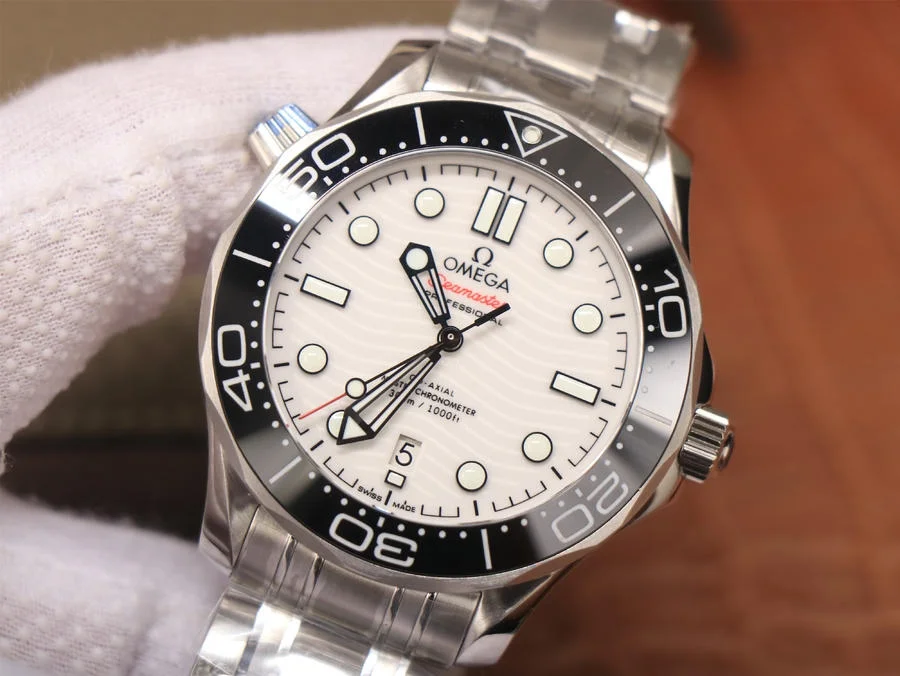
On a Diver 300M-style configuration, the dial wave pattern, skeletonized hands, applied markers and helium escape valve form a recognizable system. Inspect the wave depth and regularity, marker alignment, luminous fill, hand finishing and the relationship between the 10 o’clock valve and case. If the chosen genuine reference has no date, a date window is not a small variation—it indicates a different reference baseline.
The bezel should rotate with deliberate, even action and align at 12. A video can reveal excessive back-play or uneven resistance. Crown threading should start without cross-threading, but repeated unnecessary operation during QC should be avoided. External construction still does not prove pressure resistance; request a real test if that feature is material to the purchase.
Set a photography standard before judging small details
Compressed chat images can create false edges around polished hands, markers and the ceramic dial. Request original-resolution files where possible, with one neutral-light overview and targeted macro frames. The watch should be photographed without a strong beauty filter, extreme sharpening or a colored light source. A ruler or measurement tool belongs in the same plane as the feature being measured; otherwise perspective can distort the result.
Keep the hands away from the logo, date and key dial text in at least one image. Ask for paired left- and right-side case views from similar distance so crown, valve and lug geometry can be compared fairly. This simple repeatability makes QC more useful than a larger set of inconsistent photographs.
Build a useful approval record
Save the product URL, selected style, quoted movement description and the final QC evidence together. Note whether the watch was evaluated visually only or whether timing or pressure testing was provided. This record is more valuable than a generic factory ranking because it follows the unit that will actually be dispatched.
Use the Omega Seamaster 300M configuration as a current catalogue example and keep the Global Buyer Guide open when reviewing QC and delivery steps.
Reference sources: Omega’s official press information on the 2024 Seamaster Diver 300M range and the independent METAS Master Chronometer certification overview. Omega and METAS do not endorse this independent comparison.
Buyer questions