Reference families · Panerai buyer research
Panerai searches often combine very different case families. Resolve Luminor, Radiomir or Submersible first, then compare the exact PAM configuration.
Panerai superclone intent starts with the PAM reference
Queries such as “Panerai superclone,” “super clone Panerai” and “Panerai super clone” are broad because the catalogue spans distinct case forms and functions. The PAM reference controls the useful comparison: case family, diameter, crown system, dial layout, seconds position, date, power-reserve display, material and strap package.
Do not compare a Radiomir PAM687-style case against a Luminor Submersible PAM684-style checklist. The first emphasizes wire-lug or cushion-case language and crown proportions; the second adds a rotating dive bezel and a different case architecture. A correct detail on one family can look wrong when judged against another.
Luminor, Radiomir and Submersible checkpoints
Panerai’s large, open dials make typography and hand alignment easy to inspect. Use a level front image for numerals, indices, seconds, date and luminous areas. Then use side views for case thickness, crown architecture and crystal relationship.
Case, crown bridge and bezel evidence
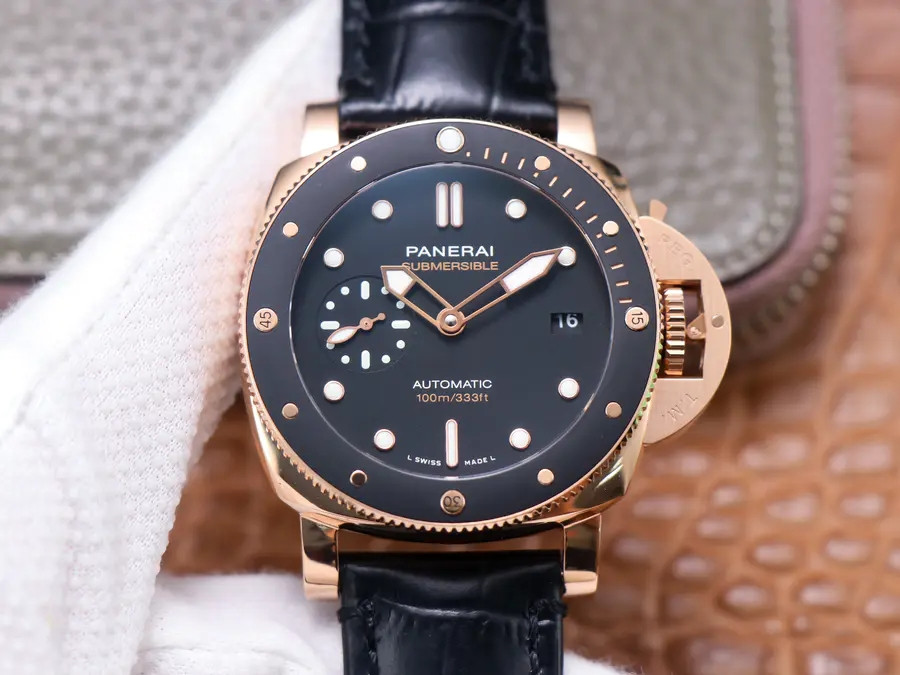
On applicable Luminor and Submersible configurations, inspect whether the bridge sits evenly against the case, the lever follows the intended arc and the crown is held securely when closed. Surface transitions should be consistent around the bridge and case. A short video should demonstrate winding and setting once; repeated aggressive operation adds risk without adding useful evidence.
For a Submersible-style configuration, review bezel insert or scale alignment, click consistency and visible back-play separately from water resistance. A rotating bezel can function correctly while the case still lacks a unit-specific pressure result.
Dial, lume, movement and reserve claims
| Claim | Visible evidence | Separate record needed |
|---|---|---|
| Sandwich or layered dial | Level and oblique macro photographs | None for visible construction |
| Lume consistency | Evenly charged low-light photograph | Duration testing if claimed |
| Movement identity | Caseback or opened movement view where appropriate | Plain-language SKU record and service path |
| Power reserve | Indicator movement where fitted | Dated run-down test for actual duration |
| Water resistance | Not established by photographs | Unit-specific pressure test |
Strap, buckle and wrist-fit record
The strap is structurally important on a large Panerai-style case. Confirm width at the lugs, length, taper, material, stitching, keepers and buckle. Photograph both faces and the attachment points. If an additional strap is included, record it with the order instead of assuming a product image represents the delivered package.
Case diameter alone does not predict comfort. Thickness, lug projection, strap stiffness and buckle position affect fit. Keep the exact product measurement separate from any official genuine-reference specification.
Use one approval file from product to dispatch
- Record the complete PAM reference-style identity
- Confirm case family, size, material and dial
- Inspect crown system and bezel where applicable
- Check strap, buckle, spare components and tools
- Request measured or pressure evidence separately
- Save final QC media with the selected SKU
See the Panerai Luminor Submersible PAM684 configuration for a model where bezel, crown bridge, case finish and strap need one coordinated review.
Questions from search